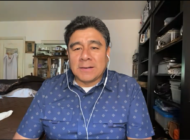
Lucinda Solórzano, a first-generation college student and daughter of Mexican immigrants, found her Chicana identity through education and activism.
By Robert Andaluz
Adapted by Katherine Méndez Hernández
Illustration by Angelina Rassam
EL NUEVO SOL
My name is Lucinda Solórzano, and I was born and raised in the city of Santa Ana in Orange County, California. My parents immigrated to the United States, so that makes me a daughter of immigrant parents, and I’m also a first-generation college student. My parents were born and raised in Mexico. My father is from Guadalajara, and my mother is from El Rincon, Jalisco. I attended California State University, Northridge after I transferred from Santa Ana College. I transferred in 1996 as a junior, then left after my first semester and returned in the fall of ‘97. I walked, but technically, I had not completed my coursework in Chicano Studies, so I officially graduated from CSUN in 2005 with a bachelor’s degree in Chicano Studies.
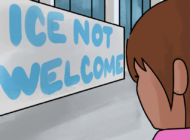
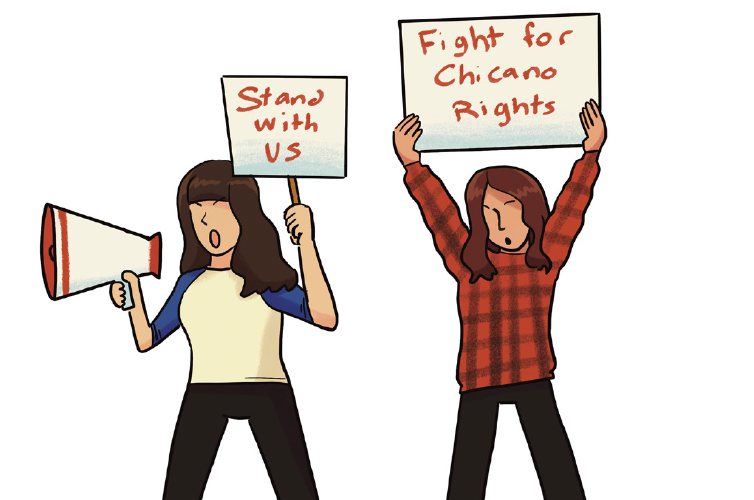
I was not familiar with chicanismo growing up; I was very much an assimilated student, and I just wanted to get along. I admired the 1980s preppy movies that would come out, and so I kind of wanted to emulate that in my life; there really wasn’t a lot of chicanismo growing up. It wasn’t until 1990 that I started at Santa Ana College and started participating in things such as Mecha and taking Chicano Studies courses, as well as participating in some of the protests that were happening during that time. That was a very volatile time; we were attacked. The immigrant community was being attacked by Governor Pete Wilson during that time, so there was a lot of opportunity to build my chicanismo through what was happening. I went to protests at the border, similar to what we saw, where a lot of people were protesting in downtown Los Angeles, by Overa Street. There was a massive protest there in the 1990s, but it was in culmination with the Chicano Moratorium anniversary. This was celebrated on the 20th anniversary of the Chicano Moratorium in August. This was the beginning of my freshman year at Santa Ana College. It was my older sister who recruited me to attend the protest, and we were protesting 187 and 209, these were assembly bills that wanted to cut funding for social programs for the undocumented community, as well as the English-only type of legislation that was recently signed by President Trump. Our community has always been attacked, and we’re always going to stand up and resist.
I didn’t know the history that CSUN had in the 1960s as being one of the main schools that promoted change and was seeking ethnic studies and Chicano Studies. You had students protesting, wanting representation, teachers, and administrators. I think learning history by attending every semester and every event just strengthened my understanding, my knowledge of that time, and the value of the historical context in the place where I was attending. At the time I attended, we still had a lot of pioneers who participated in some of those protests. Listening to their stories and their struggles, they were students of the godfather of Chicano Studies, Dr. Rudy Acuña. It was very significant, hearing his stories, and he was always a big supporter of students and advocating for us to be involved in the community. We had a lot of push within our staff that nurtured our activism. It was through the professors and staff that really enriched our experience there in the Chicano Studies Department.
I volunteer within my community, and I do what I can because my family comes first. I’m raising my children with the mindset that they have the power to make change. I always wanted to convey that to my kids, and they have a responsibility to participate in making change, because they come from a place of privilege, being born in the U.S., and because they’re in a different economic status. Since earning my college education, I’ve been able to obtain a good-paying job, and my children have a home, security, and insurance. Although some people may see these things as basic, they represent so much to us, and we continue to stay connected to our immigrant community. That’s our basis. We have a place of privilege, and so it is our responsibility. I hope I’ve conveyed to my children that they must help. They have a responsibility to help when they can. I do that in my job, I’m a social worker in the county of Orange, and for the past 18 years, I’ve tried to empower youth in care to be resilient and to see beyond their current situation, and empower parents to fight and advocate for their rights. Social services and the child welfare system have a lot of barriers against parents, against undocumented parents, Spanish-speaking-only parents, and helping them become aware of those things, empowering them, advocating for them to be given the opportunity for services, understanding the culture right, and helping them just become more empowered as parents. I love what I do, the work that I do is with love, and I hope that families reunify, hoping that kids do better than what they were given when they’re involved in the system.
One of the things that I’m very proud of in my job is that I had the privilege of working in a program called Independent Living Program, and I helped focus on employment and College attainment for kids in care in those 10 years. We created a Spotlight Award. It’s currently called the resiliency award, and we were able to build a scholarship program that went from $100 the first time around to partnering with the Eddie Nash Foundation, a nonprofit organization here in Orange County, to provide over 10 $20,000 in scholarships.
This year, we’re going to be celebrating the 10th year of the resiliency awards. I’m proud to say that it was through a vision that I had about spotlighting kids in care because they get such a bad rap. People think they’re delinquent and that they’re not able to be successful. There are outcomes for kids, and I had an awesome supporting program manager supervisor who said, “Yeah, Lucy, let’s, let’s do it.” I like to create, and we created this. It was a small award at first, and then I had a wonderful supervisor who helped me build it. That’s how my chicanismo, my commitment to my community, comes across, and that’s just through work; I have a lot of community stuff, and the one thing that I’m most proud of is the restoration of the mural that we recently completed. It was a 33-year-old community mural that was falling apart and was not being cared for. It wasn’t complete, some things were covered over the years, and not knowing how to get help, so my brother got help from other community members. We were able to raise and get grants and be able to restore the mural. So that’s one of my biggest accomplishments as well.
Tags: Chicanismo Historias de mamá Radio Nepantla